The map that started it
In 1877, during a close opposition of Mars, Italian astronomer Giovanni Schiaparelli pointed his 22-cm telescope at the planet and saw something strange: a network of long, straight lines crisscrossing the surface. He called them canali — Italian for "channels" or "grooves." A perfectly neutral term.
English translators rendered it as "canals." That word implies construction. Intent. Engineers. From that single lexical shift, an entire civilization was born.

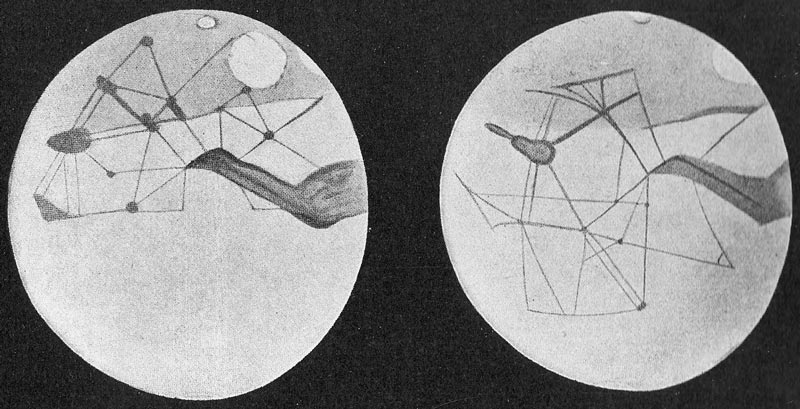
Percival Lowell, the true believer
Percival Lowell came from the Boston Lowells — old money, Harvard, the works. He had been a diplomat in Japan, written books on Asian religion, and only turned to astronomy in his forties. But when he heard about Schiaparelli's canali, he became obsessed.
Lowell founded his own observatory in Flagstaff, Arizona, specifically to study Mars. With a 61-cm telescope at high altitude, he saw not just canals, but hundreds of them. He saw them double, run parallel, converge at dark spots he called "oases." He mapped an entire hydrological system.
Between 1895 and 1908 he wrote three books: Mars, Mars and Its Canals, and Mars as the Abode of Life. The argument was airtight: Mars was drying out. The polar caps melted each summer. A dying civilization had built a planet-wide irrigation network to carry water from the poles to the equatorial cities. The seasonal darkening of the surface was vegetation growing when the canals ran.
The man who should have been believed
In 1907, Alfred Russel Wallace — co-discoverer of natural selection, the guy Darwin wrote to when he was about to publish — published a book called Is Mars Habitable? Wallace had never looked through a telescope at Mars. He didn't need to.
He did the math. Using the best available measurements of Martian temperature and atmosphere, Wallace calculated that the surface was far too cold for liquid water — something like −35°C on average. The atmospheric pressure was too low for water to exist as a liquid even if the temperature were right. Any water would either freeze or boil off. The polar caps, he argued, were probably frozen carbon dioxide, not water ice.
As for the canals themselves: Wallace noted that no geologist had ever seen a natural formation produce the kind of perfectly straight, planet-spanning lines Lowell drew. And no canal network on Earth — even the largest — could be seen from space with 19th-century optics. The lines, Wallace said, were an illusion: the eye, straining at the limits of resolution, connects faint dark patches into straight lines.
He was right about every single point. The atmosphere: too thin. The temperature: too cold. The canals: an optical artifact. It didn't matter. Lowell's books sold. Wallace's didn't.
How the illusion works
Later experiments proved Wallace right. In 1903, astronomers Evans and Maunder hung a disk with random dark blotches at the far end of a hall and asked people to draw what they saw at the limit of visibility. The drawings came back covered in straight lines — the brain connecting dots that were never connected. The same experiment was repeated with the Lowell Observatory staff themselves. Same result.
The "canals" were real features — impact crater chains, tectonic faults, albedo boundaries — that the brain, starved for detail by small telescopes and turbulent air, resolved into straight lines. When better telescopes (the 83-cm at Meudon in 1909, the Pic du Midi in 1909) finally showed featureless, line-free surface, the theory should have died then.
It didn't. Newspapers loved the Martians. Lowell kept publishing. Even as late as 1965 — a year before the first Moon landing — a NASA sourcebook still hedged on whether the canals existed.


The end of the canals
In July 1965, Mariner 4 flew past Mars and sent back 21 grainy images. The surface was cratered, barren, lunar. No canals. No cities. No water. Atmospheric pressure: 0.4% of Earth's. The canals died in a single afternoon.
And yet part of the story survives in the language. Schiaparelli's "canali" was a channel — a geological term. The English "canal" was an engineering term. One neutral observation, one badly translated word, and an entire branch of popular astronomy spent 88 years trying to prove Martians existed.